Future of Work
BROCHURE | 4 pages
#reinventingjobs Willis Towers Watson’s perspective on the future of work With so much discussion today about the future of work, it’s clear that many organizations — and the people who work in them — foresee an uncertain environment awaiting them just one, two or five years down the road. Companies are concerned, for example, that their business model will not keep pace with technology and change. The transformation of work — and Employees may envision a fully automated world in which the many implications for HR robots take their jobs or artificial intelligence (AI) renders their skills obsolete. It’s no wonder that many approach this Work is changing faster than ever before for two reasons: imagined future with caution and fear. the democratization of work, and technological change At Willis Towers Watson, we see the future of work differently. and empowerment.* We approach this challenge with a sense of opportunity and Specifically, jobs are evolving at a rapid pace with an possibility that’s grounded in fact and reality. array of options for deconstructing jobs, supporting new It’s true that change has arrived. But we know — from our skill requirements, and engaging and rewarding a broader research, our work with clients and our deep knowledge mix of workers. New employment relationships tend to be of business and talent — that this particular change brings shorter in duration and more balanced between company growth for organizations and people alike. The keys to this and individual needs. They take a more agile, responsive growth are vision and readiness; it’s essential to understand view of work than relationships that preceded them and how to achieve both, and how we can help. rely on purpose-built networks for sourcing. At the same time, individuals are more deeply empowered The future of work is already here: Where do you through technology — the likes of which we’ve not seen see yourself in it? before. Machine learning, algorithmic analytics, cloud-based Willis Towers Watson helps businesses navigate the computing, 3-D printing and sensors are all examples of changing world of work through a combination of advice, how automation augments our own capability, often for the data and software. betterment of an organization and its customers. *Source: CHREATE https://ceo.usc.edu/research/projects/chreate/
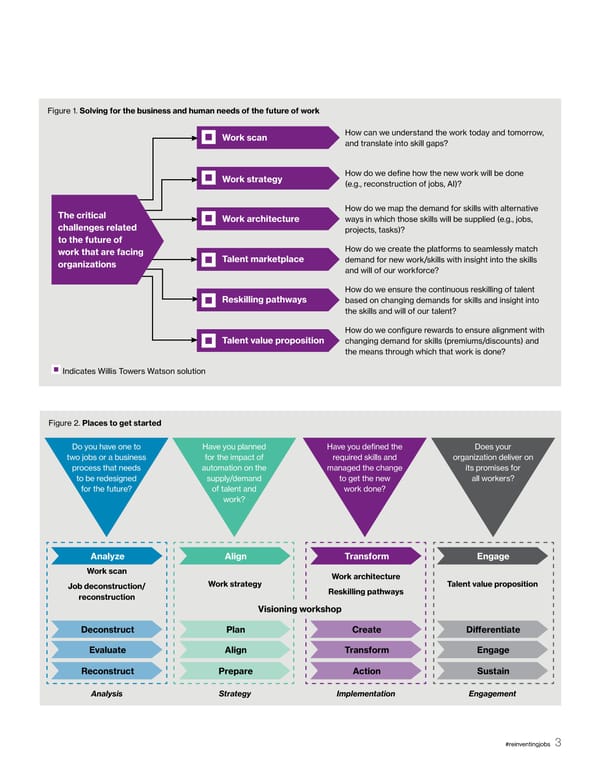
Our future of work solutions address how, where and by In the future of work, the primary impacts on whom work gets done, including by robotics and AI. They talent include shifting skills, the rise of the gig connect the requirements for work, culture and values with new ways of working and drivers of engagement for all of economy and contingent workforce, and an an organization’s talent: employees, free agents and increasing focus on work versus jobs. part-time workers. Moreover, with the use of automation expected to double Finally, our research has shown that automation affects tasks, over the next three years, our future of work solutions equip not jobs. As AI and robotics begin to proliferate within our organizations with a clear course of action enabling them to organizations, companies need to deconstruct jobs into tasks, lead through the change. We’ve helped dozens of complex redeploy them to the most optimal means — whether that is global organizations to chart a new course, tackling their robotic process automation, AI, social robotics, talent on an greatest business and talent challenges together. Recognized online marketplace or an alliance partner — and reconstruct for our world-class thought leadership in the form of books, the remaining tasks into new jobs. articles, papers and research, we possess a depth of knowledge in this space that is unmatched. All three of these factors have implications for how we design work; match talent to work; reskill, lead, engage and support How are approaches to talent evolving, and why? talent; value and reward work; and model the risks in the organization. In the future of work, the primary impacts on talent include shifting skills, the rise of the gig economy and contingent How we help workforce, and an increasing focus on work versus jobs. Willis Towers Watson helps leaders create what the future Jobs as we once knew them are evolving at a faster pace of work looks like in their organizations. We solve for the than ever before, with new skill requirements and occupations business and human needs of the future of work in six key emerging every day. We see premiums placed on some skills ways by posing and helping clients answer critical questions and discounts on others, and this skills dichotomy is creating that help frame the issues and lead to solutions (Figure 1). the need for new skill pathways within organizations. Once we’ve answered these questions, we help clients At the same time, the gig economy is on the rise. Willis implement Willis Towers Watson solutions that provide a Towers Watson’s Global Future of Work Survey revealed that toolkit and methods to: while organizations expect to reduce their percentage of full- time employees, they also anticipate using more contingent ƒƒAnalyze work, deconstructing and reconstructing jobs and workers. This includes free-agent workers, consultants or designing reskilling pathways for their talent outside agencies, workers on loan from other organizations ƒƒUnderstand the alternatives to full-time employment and free agents on a talent platform — adding quite a level of ƒƒIdentify key next steps for defining work and the talent or complexity for talent, reward and engagement strategies. reward strategies that support it ƒƒDevelop needed capabilities to sustain continuous change Figure 2 illustrates a baseline process through which we engage clients using a customized strategy for creating their own future of work. 2 willistowerswatson.com
Figure 1. Solving for the business and human needs of the future of work Work scan How can we understand the work today and tomorrow, and translate into skill gaps? Work strategy How do we define how the new work will be done (e.g., reconstruction of jobs, AI)? The critical How do we map the demand for skills with alternative Work architecture ways in which those skills will be supplied (e.g., jobs, challenges related projects, tasks)? to the future of work that are facing How do we create the platforms to seamlessly match organizations Talent marketplace demand for new work/skills with insight into the skills and will of our workforce? How do we ensure the continuous reskilling of talent Reskilling pathways based on changing demands for skills and insight into the skills and will of our talent? How do we configure rewards to ensure alignment with Talent value proposition changing demand for skills (premiums/discounts) and the means through which that work is done? Indicates Willis Towers Watson solution Figure 2. Places to get started Do you have one to Have you planned Have you defined the Does your two jobs or a business for the impact of required skills and organization deliver on process that needs automation on the managed the change its promises for to be redesigned supply/demand to get the new all workers? for the future? of talent and work done? work? Analyze Align Transform Engage Work scan Work architecture Job deconstruction/ Work strategy Talent value proposition reconstruction Reskilling pathways Visioning workshop Deconstruct Plan Create Differentiate Evaluate Align Transform Engage Reconstruct Prepare Action Sustain Analysis Strategy Implementation Engagement #reinventingjobs 3
Getting started Capturing the opportunity Not sure where to begin? Many of our clients elect to start In this time of unprecedented change, what feels like a with a one-day visioning workshop that helps them to: challenge can quickly become an opportunity. Start thinking and planning now for an imminent future, full of possibility, ƒƒGain an understanding of how digitalization is transforming around how your organization approaches the future of work, including the implications for HR and other business work — with Willis Towers Watson’s consulting and software leaders, as well as the industries represented expertise to help guide the way. ƒƒLearn to build leadership capability around the future of work, for example how to: ƒƒUpgrade an approach to getting work done with a strategy for leveraging technology and talent resources ƒƒDetermine the right path and pace of change ƒƒMatch talent and skills to emerging work ƒƒDevelop the skills required for successful leadership in the digital world ƒƒExperiment with deconstructing and reconstructing a job, and seeing for themselves the transformative implications for organizational cost, risk, capability and agility About Willis Towers Watson Willis Towers Watson (NASDAQ: WLTW) is a leading global advisory, broking and solutions company that helps clients around the world turn risk into a path for growth. With roots dating to 1828, Willis Towers Watson has over 40,000 employees serving more than 140 countries. We design and deliver solutions that manage risk, optimize benefits, cultivate talent, and expand the power of capital to protect and strengthen institutions and individuals. Our unique perspective allows us to see the critical intersections between talent, assets and ideas — the dynamic formula that drives business performance. Together, we unlock potential. Learn more at willistowerswatson.com. willistowerswatson.com/social-media Copyright © 2018 Willis Towers Watson. All rights reserved. WTW-GL-17-RES-8493y2 willistowerswatson.com